The Life & Career of Leonard Rossiter
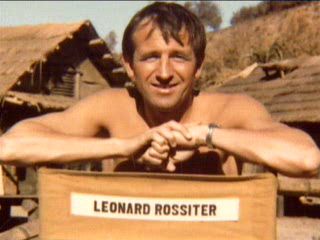
A Biography
|
|
~ |
|
~ |
|
The Life & Career of Leonard Rossiter
A Biography
On
October
21st 1926, in the bustling port of Liverpool, North West England, a
second
son was born, at home, to John and Elizabeth Rossiter, and a baby
brother
for John junior. Leonard was raised in the family home above his
father's
barber shop in Cretan Road, Wavertree, a suburb of the city of
Liverpool.
After primary school in Granby St., Toxteth, he attended the city's
Collegiate
Grammar School from 1939 to 1945. He excelled at languages and sport,
both
of which would come in useful in later life. A cheerful, modest,
punctual
and scholarly pupil, Leonard was made vice captain of the school, and
captains
of both the football and cricket teams, where he was " a slow, left-arm
bowler - in true Lancashire style". In one match the school football
team
beat their opponents 11-0, and it was Leonard who scored all eleven
goals.
He was also a member of the school's drama society. Naturally shy,
Leonard
remembers his adolescence with embarrassment: "I remember all those
dances
at The Rialto, Liverpool, where I spent every Saturday night between
10.30
and 11. Well, I hated it. The whole evening was geared to that last
half-hour.
The last waltz, or whatever. Mostly the whatever." When he started to
mix
with people from different social classes, he would always hold back if
he wasn't sure how to conduct himself: "I remember getting very hot
under
the collar at dinner tables... I was always afraid of being laughed at."
World
War Two began shortly before Leonard's thirteenth birthday, but he
still
had hopes of studying a French and German degree course at university.
His father was now a volunteer ambulance man, helping to ferry the
wounded
to Liverpool's hospitals. Tragically, in 1942, John Rossiter was killed
performing this duty during an air raid. Leonard now had to re-think
his
future, especially with regards to supporting his mother. Before then,
however, he would reach conscription age, and have to 'do his bit' for
the war effort. He joined the Education Corps. based at Bielefelt in
Germany.
By now the Germans had surrendered but the Japanese were still
fighting.
To give him an authority as instructor, he was instantly made a
sergeant.
Leonard would spend his time there teaching soldiers their ABC, and
often
had to write their letters home. Many men were less than keen to learn:
"Lots of chaps resented it", Leonard recalls. "Most of them were
totally
hardened to the idea of never needing to read or write and didn't see
why
they should start."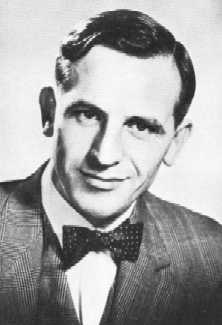
Sergeant
Rossiter was demobbed in 1948 and, despite being offered his dream
place
at Liverpool University to study languages, turned it down to become
the
breadwinner for the Rossiter household. Through a school friend he got
himself a job with Commercial Union, one of the country's largest
insurance
companies. He was a clerk in the claims and accidents department,
earning
£210 per year. Although frustrated at being tied to a desk all
day,
he stayed with the firm for six and a half years. Many years later he
would
joke about his time at the CU: "It really is amazing how many
entertainers
started life in insurance", he quipped, "and most of them will still
try
to sell you some, given half a chance." One of his colleagues in the
same
office was the late actor Michael Williams, husband of Dame Judi Dench.
Michael remembers: "Len was the most competitive man ever. We used to
play
football for the office team. Once, he passed me the ball by an open
goal.
I missed it. Len wouldn't speak to me for a week. And we sat at
opposite
desks!"
Leonard
had a girlfriend during this time who was an amateur actress with a
local
drama group. Rehearsals were over-running one night when he went to
pick
her up, and Leonard got to see their performances. He was not very
impressed
by any of them, including his girlfriend's! She challenged him to do
better,
and so he did. His daughter Camilla remembers: "He always told the
story
that his girlfriend was an amateur actress and he went along and saw
her
once and said 'I can do better than that'". Leonard himself recalls:
"Really,
it was only to see more of the girl. Then I got more interested in the
stage than I did in the girl". When he'd made the decision to become an
actor, he decided to move away from Liverpool, but "he always had a
fondness
for [the city]. He was always proud of where he came from." He became a
member of The Adastra Players, and later also joined The Centre Players
drama group, based at the Wavertree Community Centre in Penny Lane
(long
before The Beatles made it a far more famous street). With an annual
subscription
of two shillings - ten pence - Leonard was in his element, despite a
stage
measuring just 16 feet by 10 feet. Before long, Leonard was acting with
five drama societies, and his acting talents were so in demand that he
was often rehearsing for two roles while acting in another. His first
public
performance was with The Adastras in a Terence Rattigan play called
Flare
Path, in which he played the role of Flight Lieutenant Graham.
Criticism
was positive, although one critic faulted him on his rapid rate of
delivery,
something which Leonard, wisely, never rectified.
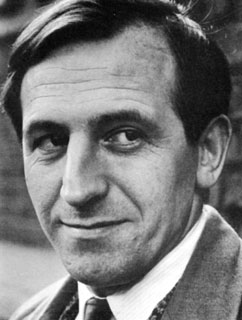 Between 1949 and 1954 Leonard acted in nearly forty plays, and soon
found
his day job getting in the way. Although now earning £10 a week
at
the CU, and barely £6 on stage, it was acting that Leonard
desperately
wanted to concentrate on - so much so that he started to have elocution
lessons to lose his Liverpudlian accent. He took the decision to leave
the insurance business and become a full-time actor. As Leonard himself
said years later, when discussing his apparently brave decision to
quit:
"It would have been far more courageous to have stayed in the insurance
business, knowing I'd be bored out of my mind for the rest of my life."
Between 1949 and 1954 Leonard acted in nearly forty plays, and soon
found
his day job getting in the way. Although now earning £10 a week
at
the CU, and barely £6 on stage, it was acting that Leonard
desperately
wanted to concentrate on - so much so that he started to have elocution
lessons to lose his Liverpudlian accent. He took the decision to leave
the insurance business and become a full-time actor. As Leonard himself
said years later, when discussing his apparently brave decision to
quit:
"It would have been far more courageous to have stayed in the insurance
business, knowing I'd be bored out of my mind for the rest of my life."
And so
it was, in August of 1954, that Leonard Rossiter, now a top amateur
actor
in the North West of England, auditioned for Preston Repertory Company,
based in the town's now-defunct Royal Hippodrome: "I think it's
C&A's
now", Leonard said in an interview. The production manager, Reginald
Salberg,
was casting a part in a production of Joseph Colton's The
Gay Dog, and Leonard tried for the part. He read the part badly,
however,
and the play's director Alan Foss had dismissed him when Salberg,
sensing
a talent, asked him to read the part again. This Leonard did, equally
badly
- but differently, and Leonard got the part. It was September 6th,
1954,
then, that Leonard Rossiter first performed as a professional actor, in
the role of Bert Gay, for £2.50 a fortnight. Co-star Frederick
Jaeger
recalls: "Len was dedicated and a perfectionist even in those days. He
was so intense about his work which meant he wasn't the most relaxed of
people... He expected everyone to work as hard as he did". So
pleased
were Reggie Salberg and Alan Foss with Leonard's performances that he
was
engaged as ASM - assistant stage manager. In all, he performed fourteen
plays at Preston Rep., until the theatre closed in the spring of 1955.
Wolverhampton
Repertory Company at The Grand Theatre was Leonard's next stop where,
from
April 1955 until the end of 1958, Leonard honed his natural talent and
skill with over fifty roles in productions of plays by such authors as
Agatha Christie, Graham Greene and Moliere.
Many productions were directed by John Barron, who became a lifelong
friend,
introduced Leonard to the world of fine wines, and later formed one of
television's most fondly-remembered worker-boss duos: Reggie
Perrin and C.J. His passion for football still as active as ever,
Leonard
used to see half of Wolverhampton Wanderers' matches at the Molyneux
(then
skippered by the late, great Billy Wright), before racing back to The
Grand
to prepare for his role (an Evertonian by tradition, Tommy Lawton was
Leonard's
footballing hero). It was at this point in his life - during rep. -
that
Leonard learned one of his most amazing skills: the ability to learn
vast
amounts of dialogue. Looking back on this time Leonard recalls: "There
was no time to discuss the finer points of interpretation. You studied
your part, you did it and then you studied the next part. I developed a
frightening capacity for learning lines. The plays became like
elastoplast,
which you just stuck on and then tore off." During this time,
television
became Leonard's second media format in 1956 when he landed a bit part
in a BBC play entitled Story
Conference, broadcast in March of that year.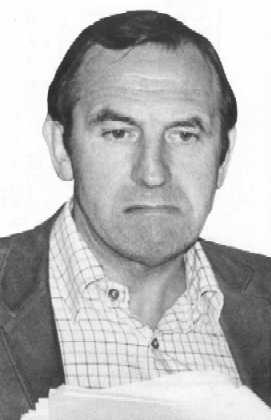
Even so early in his
career,
those who worked with Leonard found him to be an absolute
perfectionist,
and totally committed to everything he did. John Graham, Leonard's
co-star
in She
Would And She Would Not at Salisbury R ep. (based at
The Playhouse,
where Leonard spent the first half of 1959) remembers him as: "a quiet,
thinking man who observed and absorbed. He was a perfectionist and
expected
not only 100% dedication to the job in hand from himself but also from
others." A comment that echoes down the years, from theatre to film to
television. John Bowen recalls Leonard reminiscing about how great his
training was in rep.: "During his first two years, he said, everything
which could happen, did happen. Doors stuck, lights wouldn't come on or
go off, scenery fell down, rain dripped through holes in the roof,
fellow
actors dried or missed their entrances - and so did he - the curtain
fell
when it shouldn't, or refused to rise, the ASM tried to prompt from the
text of a different play. By the end of two years nothing could
surprise
him - he already knew that he could cope with it, and had the
confidence
of that knowledge". It was while at Salisbury Rep. that Leonard met a
young
actress called Josephine Tewson. They acted together in The
Food Of Love, A
Cuckoo In The Nest and Book
Of The Month, amongst others. Gradually, they became good friends,
and then lovers, and were soon married. (Josephine has since become a
familiar
face on British TV screens, for her portrayal as Hywel Bennett's
landlady
in Shelley, as Ronnie Barker's wife in Clarence, and more recently as
Liz,
Hyacinth Bucket's (pronounced 'Bouquet'!) long-suffering neighbour in
Keeping
Up Appearances).
ep. (based at
The Playhouse,
where Leonard spent the first half of 1959) remembers him as: "a quiet,
thinking man who observed and absorbed. He was a perfectionist and
expected
not only 100% dedication to the job in hand from himself but also from
others." A comment that echoes down the years, from theatre to film to
television. John Bowen recalls Leonard reminiscing about how great his
training was in rep.: "During his first two years, he said, everything
which could happen, did happen. Doors stuck, lights wouldn't come on or
go off, scenery fell down, rain dripped through holes in the roof,
fellow
actors dried or missed their entrances - and so did he - the curtain
fell
when it shouldn't, or refused to rise, the ASM tried to prompt from the
text of a different play. By the end of two years nothing could
surprise
him - he already knew that he could cope with it, and had the
confidence
of that knowledge". It was while at Salisbury Rep. that Leonard met a
young
actress called Josephine Tewson. They acted together in The
Food Of Love, A
Cuckoo In The Nest and Book
Of The Month, amongst others. Gradually, they became good friends,
and then lovers, and were soon married. (Josephine has since become a
familiar
face on British TV screens, for her portrayal as Hywel Bennett's
landlady
in Shelley, as Ronnie Barker's wife in Clarence, and more recently as
Liz,
Hyacinth Bucket's (pronounced 'Bouquet'!) long-suffering neighbour in
Keeping
Up Appearances).
Leonard
was based at the Theatre Royal, Bristol until the summer of 1961, with
the Old Vic Company, by which time he had had his first taste of
performing
in major Shakespearean productions, including The
Comedy Of Errors, Richard
II, The
Tempest and Romeo
and Juliet, which he performed at the famous Baalbek festival.
Although
still only playing minor roles, it was still a firm foundation for his
acting skills - "Our repertory system is the best theatrical training
in
the world. When my London 'break' came eventually I felt ready for it",
Leonard said. That 'break' came in June 1957, performing in front of
his
first London audience, with Josephine, when he appeared in Free
As Air at The Savoy Theatre. And another television appearance, in
1959 in a play called The
Constable's Move, ensured his talents would never be exclusively
theatre-based.
By now, Leonard was the leading man at The Old Vic, and his name was
being
uttered up and down the country, as a force to be reckoned with. The
commitment,
energy and drive he gave to each role was now more concentrated than
ever,
and he was often described as being like 'a coiled spring'. More
television
followed, and his first feature film. In A
Kind Of Loving, Leonard had just one scene, as a draughtsman in an
office with Alan Bates and James Bolam. Leonard recalls the film: "It
was
about the time that the so-called 'kitchen sink' era was well
established.
I felt much more at home in those types of plays and films. I would
never
have made it at all as an actor if there had not been that sort of
revolution
in English theatre..." Personally, however, Leonard's marriage to
Josephine
Tewson was in trouble, and they had separated. "We greatly admired each
other, in our  work",
she recalls, "But we mistook that for love".
work",
she recalls, "But we mistook that for love".
1962
was to be a better year for Leonard Rossiter. At the Belgrade Theatre,
Coventry, Leonard starred in a play about a greedy, manipulative
insurance
agent by the name of Fred Midway. The play was called Semi-Detached,
and opened on June 9th. Leonard made the part his own, and critics
raved
about his role. One of his co-stars was the actress Gillian Raine, and
by the time the play was chosen to be part of a 'British season' on
Broadway,
New York, in 1963, their working relationship had developed into a
personal
one, and the couple were in love. Gillian remembers his role as Fred
with
great feeling: "I think one sensed when one first saw him that he was
exceptional
and different, in that he had a sort of manic, farcical talent." Sadly,
the British humour of Semi-Detached was lost on American audiences, and
the play soon closed. Leonard said: "When I worked over there I came to
a firm conclusion - we are separated by a mutual language." Just to add
insult to Leonard's injury, when the play transferred to London, it was
Laurence Olivier who was cast as Fred Midway. It would be another six
years
before Leonard would get the West
End breakthrough he deserved. In the meantime, he was becoming a
familiar
face in people's living rooms when he landed the regular role as
Detective
Inspector Bamber in the popular police drama series Z
Cars. More plays kept Leonard busy during 1963, and even an
appearance
as a fancy-dress Robin Hood in an episode of The
Avengers. On the big screen, he appeared alongside Richard Harris
in
This
Sporting Life, and played a very memorable Mr. Shadrack, the
undertaker
boss of Tom Courtenay's Billy Fisher in Billy
Liar.
 By 1964, Leonard was, for the first time in his life, having to
sacrifice
theatre roles for those in other media. Theatre was always Leonard's
favourite
medium and he would always return to it whenever the opportunity
presented
itself: "You get a much greater sense of doing the job more
successfully
working in the theatre", he once said, and later "...[T]heatre is my
favourite
[medium] I suppose - audiences are very important to me." But of
course,
his biggest audiences were on nationwide television: "Many people
remember
Leonard solely for his TV work", says Gillian, "but he did more stage
work
than anything else. He got slightly annoyed whenever he was referred to
as a 'small-screen' actor". But the roles that made Leonard a household
name were still a decade or more away. In 1964, while still busy with Z
Cars, he could be seen in a supporting role in the Steptoe
And Son episode 'The Lead Man Cometh', in which he played the type
of character he was by now often getting cast as - namely, shady
criminal
types in raincoats. He also recorded his only war film at this time, King
Rat - filmed in Hollywood - in which he played a British Colonel in
a Japanese prisoner-of-war camp, with fellow prisoners including George
Segal, James Fox and John Mills. His comedic talents were now being
recognised,
and in 1965 he became a regular on the late-night satirical review show
BBC-3,
and in 1968 another satire show At
The Eleventh Hour. Plays For Today and similar dramas continued to
occupy Leonard throughout the mid-sixties (including a BBC version of
one
of his favourite theatre productions
Semi-Detached),
and no less than five films were released in 1966 in which he played at
least a minor role, opposite stars such as Michael
Caine, Edith
Evans and Joan
Fontaine.
By 1964, Leonard was, for the first time in his life, having to
sacrifice
theatre roles for those in other media. Theatre was always Leonard's
favourite
medium and he would always return to it whenever the opportunity
presented
itself: "You get a much greater sense of doing the job more
successfully
working in the theatre", he once said, and later "...[T]heatre is my
favourite
[medium] I suppose - audiences are very important to me." But of
course,
his biggest audiences were on nationwide television: "Many people
remember
Leonard solely for his TV work", says Gillian, "but he did more stage
work
than anything else. He got slightly annoyed whenever he was referred to
as a 'small-screen' actor". But the roles that made Leonard a household
name were still a decade or more away. In 1964, while still busy with Z
Cars, he could be seen in a supporting role in the Steptoe
And Son episode 'The Lead Man Cometh', in which he played the type
of character he was by now often getting cast as - namely, shady
criminal
types in raincoats. He also recorded his only war film at this time, King
Rat - filmed in Hollywood - in which he played a British Colonel in
a Japanese prisoner-of-war camp, with fellow prisoners including George
Segal, James Fox and John Mills. His comedic talents were now being
recognised,
and in 1965 he became a regular on the late-night satirical review show
BBC-3,
and in 1968 another satire show At
The Eleventh Hour. Plays For Today and similar dramas continued to
occupy Leonard throughout the mid-sixties (including a BBC version of
one
of his favourite theatre productions
Semi-Detached),
and no less than five films were released in 1966 in which he played at
least a minor role, opposite stars such as Michael
Caine, Edith
Evans and Joan
Fontaine.
Although
always priding himself on getting just right the characterisations of
every
role he played, Leonard did surprisingly little research of the
background
events of his performances, especially historical detail. He expected
the
play or drama itself to set the scene and explain things for him and
his
audience: "I was dreadful at history", he wrote in his 1981 book The
Lowest Form Of Wit, adding: "Partly because of my lack of interest
in history and partly because of an in-built conviction that too much
research
leads to cranky performances, I never dug too deeply into the private
lives
of any historical characters I've attempted - Voltaire,
Hitler,
Giordano
Bruno or Richard
III. If the author doesn't achieve his aim between pages 1 and 80
no
amount of research by an actor will do it". But one of the greatest
aspects
of Leonard's art that most people who worked with him remember, was his
fantastic ability to adapt to any situation. As John Wells commented:
"Serious
actors can't do comedy, but comics as good as Len can do anything - he
showed the whole range. He was a very, very, very good actor. I think,
if you can do comedy as well as Len did, you can do anything."
Leonard's
capability as an all-round, versatile actor found him being cast in
much
more substantial, and often controvertial roles. For example, in the
BBC
drama Drums
Along The Avon, Leonard played Mr. Marcus, a crackpot who, in an ef fort
to cement good relationships with the local ethnic communities, blacks
himself up as a Muslim and a Sikh, complete with towel for turban. It
was
these kind of powerful, socially-aware dramas that were being made at
this
time, and Leonard was one of the few really powerful character actors
who
could pull off a role such as this. Indeed, his theatre portrayal of
Adolf
Hitler as a gangster-type racketeer-turned-dictator in The
Resistible Rise Of Arturo Ui was seen by many as one of the great
virtuoso
performances of our time. The play, by Bertolt Brecht, premiered in
Glasgow
in September 1967, but it was its West End debut in July 1969 at the
Saville
Theatre that made people really sit up and take notice of the
devastating
brilliance of the man in the lead role. Until that time, Brecht's plays
were never performed in London's theatre land - all the more amazing
then
that this show, with Leonard at its helm, should become such a
phenomenal
success. This became, and was to remain, Leonard's favourite
contribution
to British theatre, and few have forgotten its impact. Leonard himself
found the role had all the elements that he could play really well, and
it was a personal triumph for him. He won three awards for his
outstanding
performance as Ui, but his modesty came through, even then:
fort
to cement good relationships with the local ethnic communities, blacks
himself up as a Muslim and a Sikh, complete with towel for turban. It
was
these kind of powerful, socially-aware dramas that were being made at
this
time, and Leonard was one of the few really powerful character actors
who
could pull off a role such as this. Indeed, his theatre portrayal of
Adolf
Hitler as a gangster-type racketeer-turned-dictator in The
Resistible Rise Of Arturo Ui was seen by many as one of the great
virtuoso
performances of our time. The play, by Bertolt Brecht, premiered in
Glasgow
in September 1967, but it was its West End debut in July 1969 at the
Saville
Theatre that made people really sit up and take notice of the
devastating
brilliance of the man in the lead role. Until that time, Brecht's plays
were never performed in London's theatre land - all the more amazing
then
that this show, with Leonard at its helm, should become such a
phenomenal
success. This became, and was to remain, Leonard's favourite
contribution
to British theatre, and few have forgotten its impact. Leonard himself
found the role had all the elements that he could play really well, and
it was a personal triumph for him. He won three awards for his
outstanding
performance as Ui, but his modesty came through, even then: 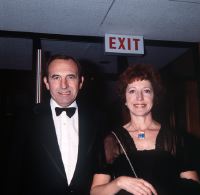 "Prizegiving
in acting is very pleasant and it's nice to win, but it's all a bit
ridiculous",
he said in a 1978 interview. "How can you compare two actors'
performances
in quite different plays? I'm not saying prizes shouldn't exist,
because
I've had a few myself, but they're not to be taken seriously".
Meanwhile,
between the premiere of Ui in 1967 and its storming of the box office
in
1969, Leonard was as busy as ever. He played the undertaker Mr.
Sowerberry
in the film version of Lionel Bart's Oliver!
("...I don't like Dickens being 'prettied up' ", said Leonard, "David
Lean's
'Oliver Twist' is more to my liking, but it was a pleasant
experience."),
and was back playing a criminal - this time an assassin for hire - in
Clement
and La Frenais' Otley.
Science fiction featured prominently for Leonard in 1968, first in the
TV play The
Year Of The Sex Olympics, and then in a cameo role on the
big-screen
in Stanley Kubrick's masterpiece 2001:
A Space Odyssey.
"Prizegiving
in acting is very pleasant and it's nice to win, but it's all a bit
ridiculous",
he said in a 1978 interview. "How can you compare two actors'
performances
in quite different plays? I'm not saying prizes shouldn't exist,
because
I've had a few myself, but they're not to be taken seriously".
Meanwhile,
between the premiere of Ui in 1967 and its storming of the box office
in
1969, Leonard was as busy as ever. He played the undertaker Mr.
Sowerberry
in the film version of Lionel Bart's Oliver!
("...I don't like Dickens being 'prettied up' ", said Leonard, "David
Lean's
'Oliver Twist' is more to my liking, but it was a pleasant
experience."),
and was back playing a criminal - this time an assassin for hire - in
Clement
and La Frenais' Otley.
Science fiction featured prominently for Leonard in 1968, first in the
TV play The
Year Of The Sex Olympics, and then in a cameo role on the
big-screen
in Stanley Kubrick's masterpiece 2001:
A Space Odyssey.
More
acclaimed theatre roles followed in the early 1970s, notably as Richard
III and Davies the tramp in Harold Pinter's The
Caretaker. He was determined that "acting shouldn't become a nine
to
five job", and was keen to avoid a 'long run' of a play: "They're a
bore",
he said. In 1972, Leonard returned to the sitcom Steptoe
And Son to play an escaped convict who took the two scrap dealers
hostage.
One person who saw that episode, and was struck by Leonard's powerful
performance,
was playwright Eric Chappell: "To come onto that show and almost
overpower
Wilfrid Brambell and Harry H. Corbett shows how strong he was." Eric
had
found the actor he needed for his play The
Banana Box.
On
a personal level, Leonard and Gillian Raine were married, and in 1972
Gillian
gave birth to a daughter, Camilla. They lived in London, off the Fulham
Road, close to Chelsea football stadium. Their house, which they shared
with their two Abyssinian cats Honey and Vicky, backed onto Brompton
cemetery,
a 38-acre sprawling Victorian graveyard, and final resting place of
such
dignitaries as the suffragette Emmeline Pankhurst, singer Richard
Tauber
and Brandon Thomas, author of Charley's Aunt. He once quipped on the
cemetary's
residents: "They're good neighbours - very little noise and no
late-night
parties!" Leonard would often unwind by strolling through the cemetery,
and reading the epitaphs. Leonard's love of fine wines, generated by
his
former director, and later Reginald
Perrin co-star John Barron way back in the 1950s, resulted in him
adding
another floor to his house: "Only a man who could so closely match
Reggie
would put his cellar in the attic!", remembers John. Leonard the
connoisseur
amassed several hundred bottles of vintage wines and, not surprisingly,
spent quite some time on his newly-added floor: "It's got glass doors along
the front" he beamed, "where I sit sunning myself and learning my
lines.
Just a hand-stretch away is the attic...!" He was quick to admit,
though,
that he and Gillian were not 'social animals': "We prefer small dinner
parties to large gatherings and seldom go out except to the theatre
(which
we do regularly). Otherwise, I read a lot and drink wine a lot!".
Leonard
would play squash once, 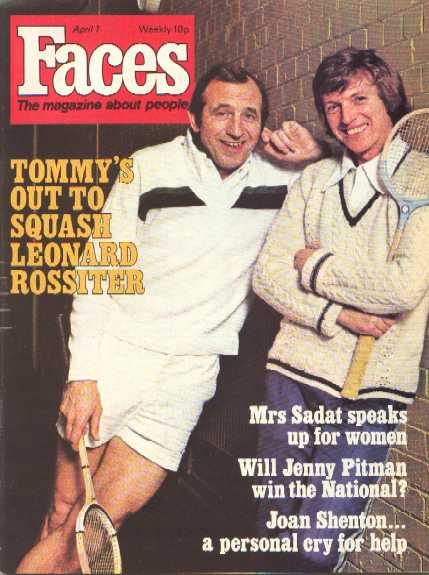 sometimes twice a day, despite only taking up the
sport at the age of 36. "I suppose fitness is important, living at my
pace",
he once said, adding "I like to win. I think fooling around in sport is
very tedious. It needs a fairly good player to outclass me now". He was
often to be seen as a member of charity cricket, tennis, squash or
football
teams, and usually a prominent member of those teams, even in his
fifties.
On his passion for cricket Leonard says: "I almost took up cricket as a
career before the War. I was a Lancashire Colt...I enjoy these sorts of
fundraising activities provided we can field a good side in both games
- it's only fair to the spectators. Just to pay good money to see a few
celebrities knocking a ball about is not very worthwhile, is it?" His
favourite
charity was the Malcolm Sargent Cancer Fund For Children, for which he
helped raise thousands of pounds over the years, in many sporting
tournaments.
Away from
sometimes twice a day, despite only taking up the
sport at the age of 36. "I suppose fitness is important, living at my
pace",
he once said, adding "I like to win. I think fooling around in sport is
very tedious. It needs a fairly good player to outclass me now". He was
often to be seen as a member of charity cricket, tennis, squash or
football
teams, and usually a prominent member of those teams, even in his
fifties.
On his passion for cricket Leonard says: "I almost took up cricket as a
career before the War. I was a Lancashire Colt...I enjoy these sorts of
fundraising activities provided we can field a good side in both games
- it's only fair to the spectators. Just to pay good money to see a few
celebrities knocking a ball about is not very worthwhile, is it?" His
favourite
charity was the Malcolm Sargent Cancer Fund For Children, for which he
helped raise thousands of pounds over the years, in many sporting
tournaments.
Away from 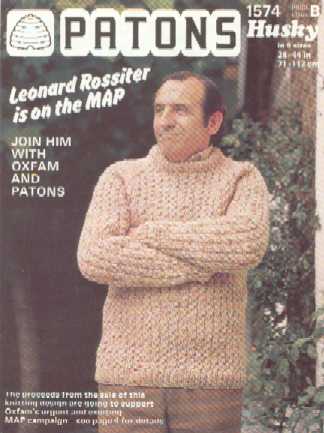 the
sports grounds, Leonard was also in demand for many other charity
events,
which he gladly participated in, including being a male model, as
exemplified
by the knitting pattern (pictured, right), proceeds from the sale of
which
went to Oxfam's Move Against Poverty campaign.
the
sports grounds, Leonard was also in demand for many other charity
events,
which he gladly participated in, including being a male model, as
exemplified
by the knitting pattern (pictured, right), proceeds from the sale of
which
went to Oxfam's Move Against Poverty campaign.
In
the
spring of 1973 Leonard, who was by now one of the country's most
in-demand
actors, starred in Eric Chappell's play
The
Banana Box, about a miserly landlord called Rooksby who,
unashamedly
bigoted and racist, finds himself landlord to a black man, and an
African
prince to boot. The play had success written all over it and Yorkshire
Television were keen to turn it into a series. And so, as 1974 came to
a close, a new situation comedy hit viewers' screens. Entitled Rising
Damp, it followed the same storyline as the play and was written by
the play's author Eric Chappell. The part of Rigsby did for Leonard on
television what Arturo Ui did for him on stage. Leonard was now a
massive
star, and any other performance (he was still recording plays and
occasional
films) were watched religiously. This was Leonard's first series,
something
he'd always tried to avoid: "I never wanted to do a series", he said in
1978, "Normally you make up your mind on the basis of the script for
the
first episode. By the time you get to the third, the standard has gone
down, and by the time you get to the fifth, you wish you'd never done
it".
It was only his faith in Eric Chappell and the strength of the story
that
Leonard decided he would do the first series. Three more series of
Rising
Damp were made, securing the programme as ITV's biggest ever hit, and
one
of the greatest sitcoms of all time. "People ask me regularly if I have
based the character on a particular landlord. Happily, I only knew
landladies
- and very nice they were, too !" Earlier in 1974, Leonard was offered
the role of Sergeant Major Williams in a new sitcom for the BBC called
It Ain't Half Hot, Mum, written by Dad's Army and Hi-De-Hi! creator
Jimmy
Perry. However, when the two men met, Leonard psychoanalysed the
character
in his usual meticulous manner, and gave Jimmy advice on changes to the
script, much to the annoyance of Jimmy Perry. Some writers took this
analysis
by Leonard as a sign of genius, others took it as 'interfering'. Jimmy
Perry was of the latter persuasion, and the role went instead to Welsh
actor Windsor Davies.
After
the runaway success of Rising Damp on ITV, the BBC were eager to grab
Leonard
for a show of their own. They had already accepted the novel The Death
Of Reginald Perrin by David Nobbs as potential for a series, and Jimmy
Gilbert, then head of comedy at the BBC, saw his opportunity at last.
Leonard
played the frustrated, middle-aged sales executive the way only Leonard
could - powerfully and brilliantly, and The
Fall And Rise Of Reginald Perrin quickly followed Rising Damp into
the realms of 'classic comedy'. But as with Rising Damp, Leonard was
wary
of committing himself to a series: "I only did it because it had been a
novel first, and the author had adapted it for television". Two more
series
followed, all three wonderfully written and staggeringly performed. But
amongst all this, Leonard continued 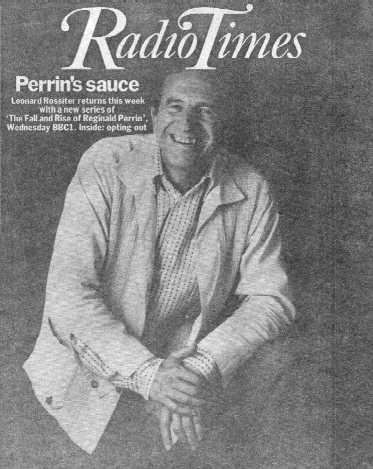 to return to his theatrical roots,
most notably as the eccentric painter Benjamin Haydon in John Wells'
play
The
Immortal Haydon. And still
to return to his theatrical roots,
most notably as the eccentric painter Benjamin Haydon in John Wells'
play
The
Immortal Haydon. And still  the
successes came. Leonard entered the world of commercials in 1977 as a
traffic
warden in an ad for Parker
Pens. But it was his teaming-up with Joan Collins in the classic Cinzano
commercials that will be remembered for ever as masterpieces of
30-second
comedies. Leonard even entered children's television, reading
storybooks
on Jackanory
and becoming the voice of Boot, in the animated version of Maurice
Dodd's
cartoon strip The
Perishers. Voice-overs for commercials
also provided work for Leonard, one of the few things he did purely for
the money: "It doesn't require a great deal of acting brightness or
intelligence.
And the rewards are inordinately high for 'going through the motions'".
He returned to his role of Rigsby for a feature-length version of the Rising
Damp series, and could also be seen as Joseph Pujol, aka Le
Petomane, who's elastic anus had the Moulin Rouge in stitches in
the
late 19th Century. For Leonard, the 1970s was, without doubt, his most
successful - and busiest - decade in his thirty year career.
the
successes came. Leonard entered the world of commercials in 1977 as a
traffic
warden in an ad for Parker
Pens. But it was his teaming-up with Joan Collins in the classic Cinzano
commercials that will be remembered for ever as masterpieces of
30-second
comedies. Leonard even entered children's television, reading
storybooks
on Jackanory
and becoming the voice of Boot, in the animated version of Maurice
Dodd's
cartoon strip The
Perishers. Voice-overs for commercials
also provided work for Leonard, one of the few things he did purely for
the money: "It doesn't require a great deal of acting brightness or
intelligence.
And the rewards are inordinately high for 'going through the motions'".
He returned to his role of Rigsby for a feature-length version of the Rising
Damp series, and could also be seen as Joseph Pujol, aka Le
Petomane, who's elastic anus had the Moulin Rouge in stitches in
the
late 19th Century. For Leonard, the 1970s was, without doubt, his most
successful - and busiest - decade in his thirty year career.
Leonard
is sometimes remembered as having had a reputation for being difficult
to work with: "It's not that I can't tolerate fools," he once said, "I
can, providing that I don't have to put up with them for too
long.
But if you find yourself sitting next to someone who continues to call
you 'Mr. Perrin, sorry I mean Rigsby', and then falls about laughing at
this wonderful turn of phrase, there's nothing much you can do except
shut
him up or leave. I usually leave." However, many people were quick to
defend
his abrasiveness: "He was a tetchy perfectionist, impatient of laziness
and circumstances in which he could not do his best work", recalls
director
Patrick Dromgoole. "But he was also generous, very generous, and
sharply
aware of the strains on those around him". Reginald Perrin co-star
Bruce
Bould sums it up by saying: "Occasionally, before a recording, Len
would
blow up at somebody. Usually there was a very good reason and if
sometimes
there wasn't you could understand that all that nervous energy and
tension
had to go somewhere, and it was a small price to pay for the superb
performances
he gave." Nevertheless, Leonard received an unusual accolade from
members
of the public, as Leonard told an interviewer on ITV's Sunday Sunday
programme
in 1984: "During the '70s, a Women's group, up in the North [of
England],
had voted me "Person You'd Least Like To Be Left Alone In A Room With"
! I wasn't quite sure what to make of that!"
In the
summer of 1979, Leonard Rossiter went into the studios of BBC Radio 4
for
a live radio interview in the slot known as Guest Of The Week. The
interview
was conducted by one of radio's most experienced broadcasters, Sue
MacGregor.
The interview was to become the start of an adulterous affair for
Leonard.
The day after the interview, Leonard rang Sue at the studios and they
went
for a drink, at the end of which Leonard asked for Sue's home phone
number.
So began a clandestine liaison lasting at least two years which saw
Leonard
paying visits once a week to Sue's flat in Primrose Hill, London,
sometimes
hiding behind a handkerchief to preserve anonymity. Sue had never been
married, but Leonard was married to Gillian Raine at this time. Details
of the affair only emerged in Spring 2002 when Sue MacGregor
published
her autobiography
'Woman Of Today'. She wrote to Gillian and Camilla before the book was
published and told her about the affair.
In an interview to publicise her book, she said: "I suppose I regret
the
affair and the unhappiness it caused both me and more importantly his
family.
But there we are, it happened and I have written about it as honestly
as
I could." In another interview for the Daily Mail, she described the
affair
in detail: "I'm not proud of my relationship with Leonard. I don't
regret
it because I loved him, but it was probably very foolish of me to have
got involved. I do think very much about his wife, actually, and his
daughter.
I feel that they must have been horribly shocked when they heard about
it. I don't think they knew anything at all about it." Their discreet
liaisons
were conducted almost entirely at Miss MacGregor's London flat. They
rarely
spent more than two hours in each others' company before he returned to
his family. They never spent a whole night together and he did not
introduce
her to his friends. Sue remembered how the actor, a wine enthusiast,
would
frequently arrive with a bottle of fine vintage. "We'd have a drink and
talk and, yes, if you put it so bluntly, then go to bed. He made it
quite
clear from the beginning that he would never leave his wife," she told
the Daily Mail. Miss MacGregor said: "I was astonished because I was
bedazzled
by him. I'd been very enthusiastic about
his acting and I thought he just wanted to have another chat. It was
rather
naive of me because it was perfectly plain that he wanted more than
that.
He took my home telephone number and started coming to my flat. In the
beginning I was just rather excited by the fact that he was interested
in me, but then I fell in love with him. It was a strange match in many
ways, but we were both quite serious people."
Leonard was
always direct and honest about what he expected from the relationship
and
never gave her the impression of being unhappy in his marriage. On her
part, Sue never suggested that he should leave his wife. "I knew he
never
would and he made that plain. It might sound naive, but I had no
intention
of breaking up his marriage," Sue said. "I'm sure he loved his wife. He
didn't string me along with any line about 'my wife doesn't understand
me'. And he was extremely fond of his daughter, so I don't feel good
about
that at all." The strain of keeping the relationship secret began to
tell
and Sue eventually demanded more. She said: "One day in the flat I just
said: 'I know that I went into this with my eyes open, but I do find
not
being seen with you in public at all very difficult. We have our
relationship
entirely within these four walls. "He said rather coldly: 'Well, you
knew
what you were entering into.' And I agreed with him. So there was
really
nothing more to say and that particular day we parted not very
amicably.
He'd only spoken the truth, but I felt miserable."
Sue
MacGregor
learnt of Leonard's sudden death backstage in the West End in October
1984
from an 8am radio bulletin. "I was having a lie in, which was unlike
me,
and I heard the newsreader say: 'The actor Leonard Rossiter died last
night.'
I felt stunned," she recalled. "I often wonder whether he'd tried to
ring
me the night he died and got no reply." Unable to grieve publicly, she
suffered panic attacks for six months after his death. When Miss
MacGregor
decided to write her book, colleagues asked if she would include
details
of the affair. Persuaded by publishers to include the relationship in
the
book, she wrote to Gillian to warn her. "Understandably, she didn't
reply
and I didn't expect her to. It wasn't an easy letter to write, but it
must
have been more difficult for her to read."
With
theatre, TV and film roles under his belt, Leonard tapped a new medium
in 1980: literature. His Devil's
Bedside Book - A Cynic's Survival Guide found him revisiting
Ambrose
Bierce's cynical definitions for everyday terms and phrases, and adding
quite a few maxims of his  own. It also contained a very
useful compendium
of Laws and Rules, such as Murphy's Law and The Peter Principle. This
was
followed in 1981 by his second book, The
Lowest Form Of Wit, a collection of some of the greatest sarcastic
put-downs from across the centuries, and from Leonard's own long and
varied
career. In 1981, he was busy filming Britannia
Hospital, a film which reflected British society of the time, where
most people were on strike, and the only funding for new projects came
from overseas. Leonard continued to return to the theatre as often as
possible,
and gave some dynamic performances in The
Rules Of The Game, Make
And Break, and Tartuffe.
1984 brought a new sitcom for Leonard - Tripper's
Day. He had turned down numerous scripts for pilots because they
were
merely "Perrin-cum-Rigsby clones", as he put it: "You have to avoid
playing
a carbon copy of someone you've done before - a very easy thing to do
if
you aren't careful." In an interview for TVTimes he said: "When I was
offered
Tripper, it was pointed out that it wasn't terribly deep stuff, just
smash-bang
basic comedy in short, sharp scenes. I said I wasn't averse to doing
anything
if I liked it", he added, "and this is fast and funny, and very well
written
by Brian Cooke." In the same interview he joked about the moustache he
wears while playing Norman Tripper. He grew it for his portrayal of King
John in a Shakespeare TV play, and kept it for Loot and the movie Water,
in which he starred with Michael Caine. He said: "Because of different
jobs overlapping I was forced to make the moustache become a fixture.
But
it definitely comes off at Christmas, and I'll be glad to see the back
of it." Sadly, Leonard never saw that Christmas. In October that year,
he played the role of Inspector Truscott in Joe Orton's Loot.
own. It also contained a very
useful compendium
of Laws and Rules, such as Murphy's Law and The Peter Principle. This
was
followed in 1981 by his second book, The
Lowest Form Of Wit, a collection of some of the greatest sarcastic
put-downs from across the centuries, and from Leonard's own long and
varied
career. In 1981, he was busy filming Britannia
Hospital, a film which reflected British society of the time, where
most people were on strike, and the only funding for new projects came
from overseas. Leonard continued to return to the theatre as often as
possible,
and gave some dynamic performances in The
Rules Of The Game, Make
And Break, and Tartuffe.
1984 brought a new sitcom for Leonard - Tripper's
Day. He had turned down numerous scripts for pilots because they
were
merely "Perrin-cum-Rigsby clones", as he put it: "You have to avoid
playing
a carbon copy of someone you've done before - a very easy thing to do
if
you aren't careful." In an interview for TVTimes he said: "When I was
offered
Tripper, it was pointed out that it wasn't terribly deep stuff, just
smash-bang
basic comedy in short, sharp scenes. I said I wasn't averse to doing
anything
if I liked it", he added, "and this is fast and funny, and very well
written
by Brian Cooke." In the same interview he joked about the moustache he
wears while playing Norman Tripper. He grew it for his portrayal of King
John in a Shakespeare TV play, and kept it for Loot and the movie Water,
in which he starred with Michael Caine. He said: "Because of different
jobs overlapping I was forced to make the moustache become a fixture.
But
it definitely comes off at Christmas, and I'll be glad to see the back
of it." Sadly, Leonard never saw that Christmas. In October that year,
he played the role of Inspector Truscott in Joe Orton's Loot.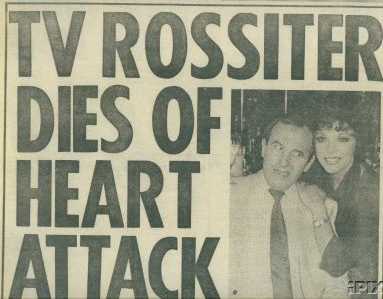 It was to be the final curtain for Leonard Rossiter. In his 1980 book
The
Devil's Bedside Book, Leonard had written "I love life and I don't look
forward to death at all." It came far sooner than anyone had expected,
least of all himself.
It was to be the final curtain for Leonard Rossiter. In his 1980 book
The
Devil's Bedside Book, Leonard had written "I love life and I don't look
forward to death at all." It came far sooner than anyone had expected,
least of all himself.
The play had opened at London's Ambassador Theatre in March to
favourable
reviews. Directed by Jonathan Lynn, it was the comic-horror tale of a
bank
robbery stash hidden in the robber's late mother's coffin, with the
body
disposed of elsewhere. Truscott, a corrupt police officer,
investigates,
and ends up sharing in the proceeds. In September, the production
transferred
to The Lyric Theatre, on Shaftesbury Avenue. It was here, on October
5th,
that Leonard suffered a massive heart attack and died. Very rarely ill,
he had been suffering some discomfort in his chest, but the doctors at
the Brompton Hospital who ran a number of tests found him to be
healthy,
and far fitter than other men of his age, 57. Leonard's co-star Neil
Pearson
remembers the events on that fateful Friday: "He'd come in, and
wandered
about in the wings before the show. He wasn't on first, but he always
did
that, just to get the 'feel of the house'. [That night, the house was
full,
and people were even standing at the back of the auditorium]. The show
started. We did the first scene. Leonard came on for the second scene,
off he went." A short while later, tannoy calls for Leonard were being
repeated, something which his fellow actors knew he never needed. They
all knew something was wrong. The actors on stage had run out of lines
and had started to improvise, after Leonard had missed his cue. David
John,
another actor in the play, rushed to Leonard's dressing room, but found
the door locked. The curtain was temporarily lowered on stage, and
Leonard's
door was forced open. He
was found sitting, slumped in an armchair. The call for a doctor went
out,
and heart massage was applied while everyone waited for the ambulance
to
arrive. By the time Gillian arrived at the theatre, Leonard had been
rushed
to the Middlesex Hospital, but he was already dead. The cause of his
death
was hypertrophic cardiomyopathy, a congenital disease of the heart
muscles.
(See the special
page on Loot for a more detailed description of the events at the
theatre
that day).
There
are many words that describe Leonard Rossiter, professionally and
privately,
and many of them appear constantly throughout the tributes and
remembrances
on the pages of this web site. Professionally, he was committed,
concentrated,
meticulous, exacting, focused, driven, inventive, fastidious,
hilarious,
and above all: brilliant and unique. Personally, he was shy,
introspective,
competitive, ambitious, eccentric, witty, honest and generous. It is
easy
to say "There'll never be another..." about anybody whose talents are
sadly
missed, but in the case of Leonard no-one put so much energy and
concentration
into his roles, and got so much out of his audiences; or could play the
entire spectrum of human emotions with such believability; or be
respected
and revered by everyone he came into contact with, from the school
playing
field to his final performance; and yet remain an ordinary family man,
his fame never changing him. That is rare. There really was
no-one
like Leonard Rossiter.
Click
here to read a page of co-stars' personal, non-performance-related
tributes to Leonard Rossiter.
|
|
Text (c) Paul Fisher
Pictures (c) their
respective
owners.