|
|
~ |
|
~ |
|
The Life & Career of Leonard Rossiter
The Resistible Rise
Of
Arturo Ui
Written by Bertolt Brecht, adapted by George Tabori
All productions directed by Michael Blakemore
September 1967
Performed at Citizens'
Theatre,
Glasgow
August 1968
Performed at The Lyceum,
Edinburgh
(as part of the Edinburgh
Festival)
April 1969
Performed at The
Playhouse,
Nottingham
July 1969
Performed at the Saville
Theatre, London
|
|
It
was
in 1967, after nearly one hundred theatre performances, that Leonard
Rossiter's
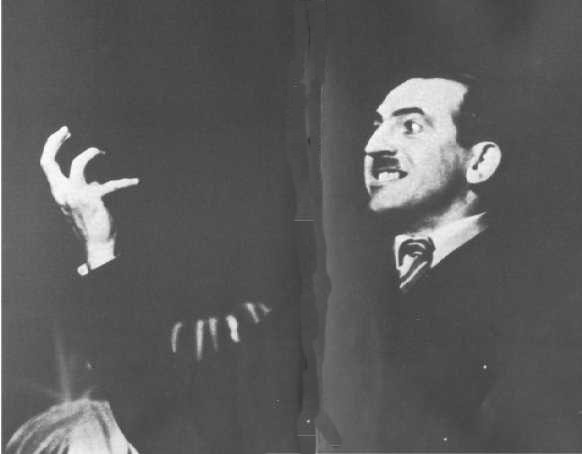
portrayal of Arturo Ui rocketed him to stardom, the West End, and into
our homes in his memorable television roles. Leonard's Ui was virtuoso
- perfect, stunning and inimitable. It was a performance still ranked
today
with the finest of those of Olivier and Gielgud. It was as if his whole
theatrical life had been a rehearsal for this role. And yet it almost
never
happened. Director Michael Blakemore wanted desperately to bring the
play
to the British stage, after the world famous production by the Berliner
Ensemble, the East German theatre company set up by Brecht himself in
1949.
Blakemore knew he wanted Leonard for the role, but Leonard was
apprehensive.
Set
amidst
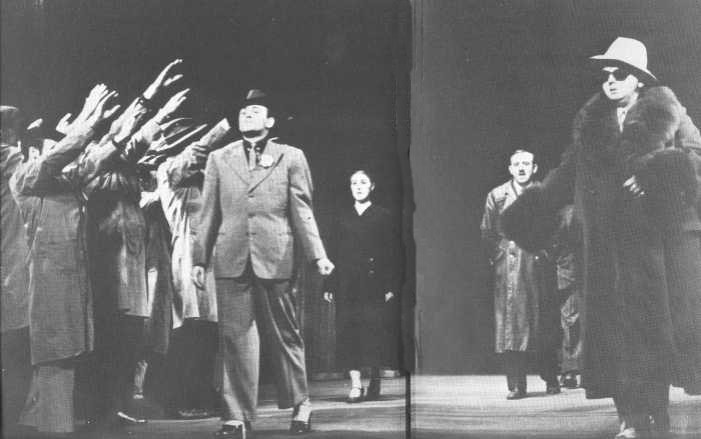
the economic turmoil of gangster- controlled Chicago in the 1930s, the
play is a direct and thinly veiled attack on German apathy towards the
threat of Hitler's rise to power, and a warning to future generations
(Brecht
was vehemently anti-Nazi, he fled to Finland where he wrote the play.
He
had decided to leave for America, and thought the equation of Hitler
with
Al Capone would give him a foothold on the American stage). Two years
before
Hitler's programmes of extermination, the dangers of his expansionist
tendencies
and his ruthless political ambition were already apparent to Brecht as
he transposes Hitler's manipulation of the German and Austrian
governments
onto a gangster's attempts, via the running of a protection racket, to
take over the cauliflower trade in the American cities of Chicago and
nearby
Cicero during the Depression (Brecht turned to his son for research
into
American gangsterism; he was a big gangster film buff). Initially
dismissed
as an uncouth upstart, the gangster Ui, like Hitler and Al Capone, uses
a mixture of violence, incendiary speech and mesmerizing rhetoric to
further
his mafia-like promotion of brotherhood and blood ties. Ui and his
group
of maniacal followers force their way into power, ruthlessly
exterminating
dissenters and critics and finally achieving support and recognition
from
the vegetable traders of Chicago and Cicero.
Leonard
was unsure that he could pull off a Chicago Al Capone-like accent, but
after a reading in the flat of Michael Blakemore, the director
reassured
him that his rendition was most convincing: "...I had no anxieties
about
him", recalls Blakemore. "Once he had agreed to be in it... he saw the
part as an opportunity to deploy the full range of his gifts and,
swooping
between the comic and the grotesquely sinister, he went for the throat."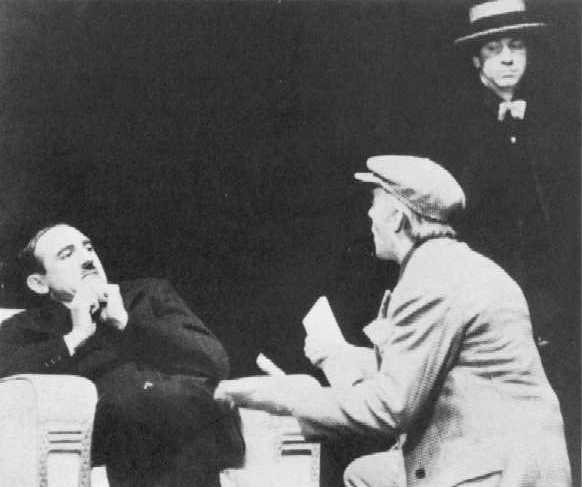
The
premiere
was set for September 1967 at the Citizens' Theatre in Glasgow, but
with
only a week for rehearsals, compared to the Berliner's six months,
things
had to move at an incredible pace. Of course for Leonard, with his
ability
to digest vast amounts of dialogue at the same time as working out his
moves and gestures, this posed no problem, but for the costume and set
designers, it was a different story. Even on the opening night, the
final
scene - one of the most memorable of the whole play - had not been
properly
dress rehearsed and the cradle in which Arturo glides towards the
audience
during his climactic speech, had still not been fully tested. However,
luck was on their side, and the play had no problems. Leonard
captivated
the audience with his horrific, sinister, and yet sometimes maniacally
comic, 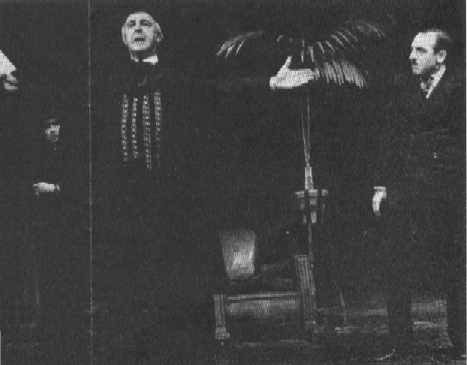 performance.
From seedy, small-time gangster to the controller of the Chicago
grocery
trade, Leonard brilliantly showed how one man - metaphorically Hitler -
could instil such hysteria and power amongst his racketeers and his
victims.
The play was given even more potential by the use of all dialogue being
in verse, and with a constant dull ack-ack of machine-gun fire in the
background.
performance.
From seedy, small-time gangster to the controller of the Chicago
grocery
trade, Leonard brilliantly showed how one man - metaphorically Hitler -
could instil such hysteria and power amongst his racketeers and his
victims.
The play was given even more potential by the use of all dialogue being
in verse, and with a constant dull ack-ack of machine-gun fire in the
background.
The
play
returned for a second run the following year, still in Scotland. It was
performed as part of the annual Edinburgh Festival at The Lyceum in
Edinburgh,
to packed houses and excellent reviews. It transferred to The Playhouse
in Nottingham in April of 1969, where the play - and its actors,
particularly
Leonard - gained stature as a production and an actor not to be missed.
Finally, the performance reached the London audiences in July of the
same
year. Staged at the Saville Theatre in the West End, the production
played
to the country's top - and fiercest - critics. But the verdict on the
play,
and on the actor playing the lead role, was unanimous: "stunning",
"perfect",
"a virtuoso performance", "electrifying", "astonishing". Leonard was
the
toast of the town but, as ever, never let his new-found stardom go to
his
head. Nevertheless, he was quick to promote his talents: "You could say
I'm at my best at strong characters with a manic streak", he told Bryon
Rogers in an interview with TVTimes, "I like roles such as Hitler where
you can go from outraged hysteria to assumed calm in seconds. I think I
am better equipped to do that than most."
Everybody
who was anybody came to see the play, and seeds were sown for many of
Leonard's
subsequent performances, not least as the manic painter Benjamin Haydon
in John Wells' play, specially 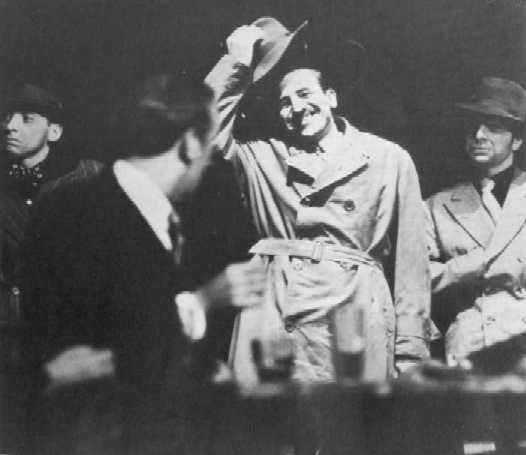 written for Leonard, The
Immortal
Haydon.
John fondly recalls Leonard's overpowering presence on stage as Ui:
"[It
was] the first time
I really went mad about Len... he took the play and you could see the
underpinning
of his comedy because it was absolutely real . He had
an
extraordinary power... in that he could actually bring the audience to
him. He didn't go out to the audience, he could actually bring
them
in, by the intensity of his concentration." His unforgettable
performance
won him three awards: The Variety Club of Great Britain Award, the
Scottish
Television Theatre Award and, voted for by theatre audiences, the
'Plays
& Players' Award. Leonard himself claimed his role of Arturo Ui
as a personal triumph. Years later, in a rare interview with Russell
Harty,
he was asked which of the many parts he had played over the years held
an affinity for him. He replied: "...Very, very rarely, on about two
occasions,
I suppose, in 28 years, have I thought 'Ah, this gives me all the
things
I can do really well'. One of them was Rising Damp, the other was a
play
about Hitler!" He ended by joking "So clearly, I am a dictator
manqué!"
written for Leonard, The
Immortal
Haydon.
John fondly recalls Leonard's overpowering presence on stage as Ui:
"[It
was] the first time
I really went mad about Len... he took the play and you could see the
underpinning
of his comedy because it was absolutely real . He had
an
extraordinary power... in that he could actually bring the audience to
him. He didn't go out to the audience, he could actually bring
them
in, by the intensity of his concentration." His unforgettable
performance
won him three awards: The Variety Club of Great Britain Award, the
Scottish
Television Theatre Award and, voted for by theatre audiences, the
'Plays
& Players' Award. Leonard himself claimed his role of Arturo Ui
as a personal triumph. Years later, in a rare interview with Russell
Harty,
he was asked which of the many parts he had played over the years held
an affinity for him. He replied: "...Very, very rarely, on about two
occasions,
I suppose, in 28 years, have I thought 'Ah, this gives me all the
things
I can do really well'. One of them was Rising Damp, the other was a
play
about Hitler!" He ended by joking "So clearly, I am a dictator
manqué!"
Leonard's Role
Remembered:
"...He made the role his
own. It was brilliant caricature... Highly stylised and grotesquely
funny
(though never any the less frightening for that), he was a cartoon
figure,
constantly being galvanized into convulsive movement and snarling
fury...
an unforgettable experience." - Robert Tanitch.
"...As an actor he had
much
in common with the great performers of an earlier generation, a
self-sufficient
talent forged out of necessity in the provinces. He was enormously
inventive
and from the outset had a clear idea of what he wanted to do with a
part...
It soon became clear that what Leonard was offering was so alive and so
charged with comic intelligence that it simply couldn't be denied." -
Michael
Blakemore, director.
"You had to be on your
toes
when you acted with Leonard. His speed of thought on stage was like
lightning.
I never saw him hesitate or fluff during a performance. He blazed with
energy and liked you to blaze with him. His Arturo Ui was an
unforgettable
experience - a great performance, one of great power, dazzling comic
invention
and marvellous physical dexterity." - David Graham, co-star.
"Certainly his most
impressive
performance, his most memorable performance as far as I'm concerned,
was
in Brecht's "...Arturo Ui", which is a play set in Chicago, among
gangsters,
featuring the Hitler gang... and Leonard playing Hitler was
extraordinary.
He frightened me. He probably would have frightened Hitler too." -
James
Grout, producer.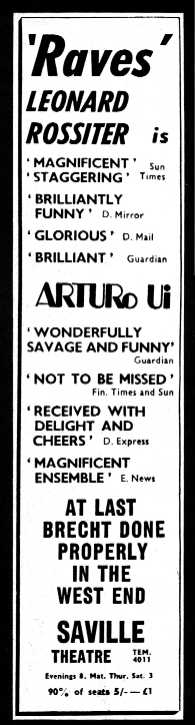
"Out of the handful of really great performances I have been privileged to witness, including two by Olivier, Leonard's Arturo Ui was one of the greatest. His natural talent apart, it was the perfect example of the actor meeting the character head on and fusing it into one, combining concentration and energy into an awesome performance." - Peter McEnery, director Richard III (starring Leonard, after McEnery saw his Arturo Ui).
"He was drawing on his rage against hypocrisy, pomposity and dishonesty...He was a very angry man like most funny people." - Jonathan Lynn, director.
"Leonard Rossiter's
performance
in the title role of Arturo Ui has to have a place in my list of truly
outstanding performances... it was so mesmerizing, a performance of
such
galvanic power... that I saw it four times more." - Alan Strachan,
director,
Semi-Detached.
Critical Reviews:
"Leonard Rossiter's
virtuoso
performance. This is the most vivid, compelling and hilarious acting
currently
on view on the London stage. It can best be described as volcanic: it
alternates
between menacing, brooding inertia and eruptions of hysterical
violence.
The loathsome obsequiousness, the foxy charm, the startled backing into
the furniture, the ever-present awareness of himself as an actor
calculating
effects, make up not only a great performance but a great Brechtian
performance."
- Frank Marcus, Sunday Telegraph.
"...The part of Arturo Ui gives a wonderful opportunity for a virtuoso performance and this production is fortunate in having discovered just the virtuoso actor for it. Leonard Rossiter is, in my opinion, better than even the Berliner Ensemble's star Ekkehard Schall, in the part; Schall, basically, is a heroic actor and had to work harder to bring out the seedy, middle-aged, born-to-failure aspect of Ui, which Leonard Rossiter, a character man from the start, does to perfection. Rossiter's performance is Chaplinesque in the best sense of the word - it is grotesquely comic and yet displays the control of movement one associates with ballet. And each movement has its own transparency, behind the actual gestures one senses the process of thought or emotion which has led to it..." - Martin Esslin, Plays & Players.
"This is a glorious caricature, beautifully worked out. His Ui grows from a cringing, twitching, indeed almost endearing little bully into a ranting, psychopathic monster." - Barry Norman, Daily Mail.
"Leonard Rossiter gives a terrifying, demonic performance as Ui (Hitler) of a virtuosity to make one gasp with astonishment." - Adrian Brookholding-Jones, Tablet.
"There is a dazzling, grotesquely comic, unforgettable performance by Leonard Rossiter." - Matthew Coady, Sunday Mirror.
"...In this astonishing
performance
Mr. Rossiter combines the bold lines of caricature with subtle
shading."
- Felix Barker,
Evening News.
"A tremendous performance,
the funniest and technically the most brilliant in the West End at the
moment. Eyes popping like eggs, he lopes across the stage, fawning on
the
eminent, baring his deadly smile, squawking in terror when a chair
gooses
him." - Jeremy Kingston, Punch.
"Mr. Rossiter is perfect - a trampled paranoid, comically mean minded with the timing of a comedian and, stealthily developing, the arrogance of a madman. Even at his funniest, Mr. Rossiter never lets us forget the gas chambers, the bombs, the slaughter." - Clive Barnes, New York Times.
"It is a magnificent performance which starts in laughter and ends in menace. It should not be missed." - David Nathan, The Sun.
"The star in question
(a
term that cannot be withheld after this performance) is Leonard
Rossiter
whose account of Brecht's Chicago hoodlum Hitler is one of the most
staggering
examples of grotesque comedy I have ever seen." - Irving Wardle, The
Times.
Return
to Theatre Performances - 1960s
Return
To Index Page
Text (c) Paul Fisher
Pictures (c) their
respective
owners.