Rigsby Online:
The
Authorised Rising Damp web site
The Story of Rising
Damp
Related pages: Episode
Summary & Scene Guide - Video
Clips
The TV Series and Spin-offs
| The
Television Series:
Written by Eric
Chappell
Broadcast by
Yorkshire Television
Pilot:
Produced by Ian
MacNaughton
September 1974
Audience: 6.1
million
Series One:
Produced and
Directed by
Ronnie Baxter
December 1974 to
January
1975
Audience: 6.5 million
|
Series Two:
Produced and
Directed by
Ronnie Baxter
November to December
1975
Audience: 7
million
Series Three:
Produced and
Directed by
Ronnie Baxter
April to May 1977
Audience: 8.2
million
Series Four:
Produced and
Directed by
Vernon Lawrence
April to May 1978
Audience: 18.6
million
|
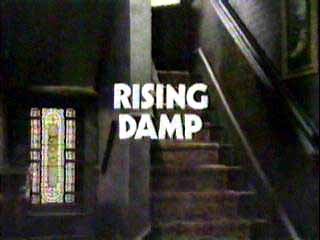 Automatic Pilot
In
1955,
Britain's second television channel was launched. It was called ITV,
and
it was a commercial channel, funded by corporate advertising. It was
also
split into regional autonomies, including HTV in Wales, Scottish
Television
and Ulster. A further regional broadcaster, and maker of programmes,
was
Yorkshire Television, or YTV. And it was in 1973 that the Head of Light
Entertainment at YTV, John Duncan, was invited to see a performance of
a play at the Theatre Royal in Newcastle-upon-Tyne. The play was called
The Banana Box and Duncan saw its potential as a sitcom immediately. A
series of half-hour sitcom pilots were commissioned by YTV for
broadcast
in the autumn of 1974, by which time John Duncan had been replaced by
Duncan
Wood, a more experienced producer from the BBC. The series of six
comedies
were: You'll Never Walk Alone (written by Ray Galton and Alan Simpson,
and starring Brian Glover); Brotherly Love (starring Keith Barron);
Badger's
Set (written by Barry Took, and starring Julian Orchard and Gwen
Taylor);
Slater's Day (starring John Junkin); Oh No, It's Selwyn Frogit!
(starring
Bill Maynard); and Rising Damp. Up against so many good writers and
acting
talent, it was only the latter two pilots which evolved into full
series,
with Rising Damp having a respectable audience of 6.1 million when it
was
broadcast on 2nd September 1974.
Unbeknown
to the watching public, there were major differences between the pilot
and the original play. For one, the main character's name had changed!
In a promotional interview for the pilot, Leonard Rossiter said words
to
the effect that 'if you didn't like Hitler, you won't like Rooksby!' A
real Mr. Rooksby from Scarborough (who happened to be a landlord!),
took
offence to this, and Eric had to quickly scan the telephone directory
for
a similar name. As the title of the pilot episode was also to be called
'Rooksby', this too had to be changed, and it became
The
New Tenant. It was also quite late in the production of the pilot
before
Eric Chappell decided The Banana Box was not a suitable title for the
programme,
and instead used part of a character's line in the script "[I've
got]...rising
damp!". That character, Alan, was played by a newcomer to the story, as
the other three (Leonard, Don Warrington and Frances de la Tour) had
survived
the change from theatre to TV and simply resumed their roles. Richard
Beckinsale
had been seen by Eric Chappell in the Jack Rosenthal comedy The Lovers,
and knew he would be right for the part of the innocent, naive medical
student Alan Moore. The other major difference was that the black
student
Philip was the new arrival at the boarding house, while Alan was the
resident.
In The Banana Box, it was Philip who was resident, and Noel the arrival.
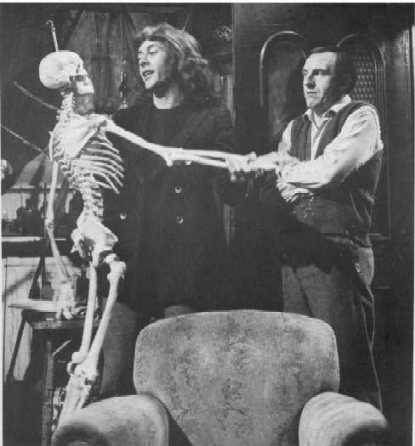 Although
the script of 'The New Tenant' borrowed heavily from the original play,
the introduction of close-up camera work, lighting and more detailed
sets
served to enhance the setting, the story, the performances of the
actors
and consequently the audience reaction. This was to the great relief of
the writer, as Eric remembers: "I was thinking 'How are we going to get
through week after week?' because I wasn't always going to write stuff
that was hilariously funny... And then I realised how we were going to
do it - when I saw Len's reaction that first week when he realised he
was
stuck with an African student, and the audience roared with laughter, I
thought 'He hasn't said anything yet!'...and so I thought 'Eric, you're
home and dry because when you're stuck for a line, he's going to finish
the scene for you.'" The great physical gestures and mannerisms of
Leonard
Rossiter were being seen for the first time, something that could never
be seen in all their glory on stage.
Although
the script of 'The New Tenant' borrowed heavily from the original play,
the introduction of close-up camera work, lighting and more detailed
sets
served to enhance the setting, the story, the performances of the
actors
and consequently the audience reaction. This was to the great relief of
the writer, as Eric remembers: "I was thinking 'How are we going to get
through week after week?' because I wasn't always going to write stuff
that was hilariously funny... And then I realised how we were going to
do it - when I saw Len's reaction that first week when he realised he
was
stuck with an African student, and the audience roared with laughter, I
thought 'He hasn't said anything yet!'...and so I thought 'Eric, you're
home and dry because when you're stuck for a line, he's going to finish
the scene for you.'" The great physical gestures and mannerisms of
Leonard
Rossiter were being seen for the first time, something that could never
be seen in all their glory on stage.
The Pressure Is On
So
pleased
were YTV with the audience reaction and critical praise of The New
Tenant
that a series was immediately commissioned. Although ecstatic at the
decision,
it was a daunting prospect for Eric Chappell as he had already had one
sitcom to write. At the same time he had submitted the script for The
New
Tenant to YTV, he had submitted a script about office politics and
relationships
called The Squirrels to another ITV regional broadcaster, ATV. They had
commissioned Eric to write a full series of this sitcom, too, so Eric
now
had two scripts to write. With a young family to bring up, Eric found
himself
getting up early in the mornings to write, but with only seven weeks to
write five Rising Damp scripts (and with three drafts per script
meaning
one script took three weeks), Eric soon became mentally and physically
exhausted. He advised YTV to get in other writers to finish the Rising
Damp scripts, but Leonard Rossiter was furious: "When Len put his foot
down, it stayed down", Eric remembers. "He said he'd contracted to do a
series written by me and that was what he intended to do." Eric was
instead
given a six-week break, and returned refreshed to his typewriter, while
other writers took on the task of penning the scripts for The Squirrels.
A vast
amount of work goes on behind the scenes of a sitcom, and Rising Damp
was
no exception. Each episode took one week from the receipt of the script
to the recording. Scripts would be amended, then a read-through would
take
place in London. For the first series this happened at St. Paul's
Church
Hall in Hammersmith. For the other series, it took place at the
Sulgrave
Boys Club in Shepherd's Bush. Studio times would be booked, any
additional
casting of peripheral characters would be made, and all involved
members
of staff would attend the rehearsals: designer, wardrobe, make-up
artists,
cameramen, all noting down the requirements their particular department
calls for for each episode. They would then return to Leeds to gather
props
and set the scene in the studio. The actors would arrive in the Leeds
studio
for rehearsals on Fridays, first for a camera position run, then a
dress
rehearsal, and then the recording in front of a studio audience, who
would
arrive at 7.30pm. The cast would then travel home on Saturday, and the
whole thing would start over again on Sunday.
The set
designer, Colin Pigott, was in his element working on Rising Damp. The
cramped surroundings of the bedsit were easy to cater for: cheap,
miserable
wallpaper and tatty carpets. The sets were actually scaled down to
further
enhance the cramped, claustrophobic atmosphere. For example, the beds
in
the students'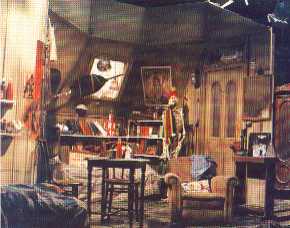 attic room were far too short
to sleep in, but the viewer
never got to see the whole bed, so it went unnoticed, and the attic
room
itself was built on an elevated stage, so that anyone exiting through
the
door really would have to 'go downstairs'. The lighting, too, was
fittingly
dull for a squalid bedsit, giving the appearance of a solitary light in
the centre of each room, and illuminated by a low-watt bulb at that.
Even
the characters' costumes had days of research put in to them. It was
decided
that Rigsby should wear plimsolls around the house, so that he could
appear
in his tenants' rooms without detection. His threadbare cardigan was
picked
up from a charity shop and his trousers were polished to provide that
'well-worn'
look. Don was always well-dressed, as befits an apparent African
prince,
and Alan had to wear a wig until the episode Stage Struck as Richard
Beckinsale
was playing a convict (with obligatory short-cropped hair) in Porridge
at the same time as recording Rising Damp. Even Alan's training
anatomical
skeleton becamely progressively clothed as the series went on.
attic room were far too short
to sleep in, but the viewer
never got to see the whole bed, so it went unnoticed, and the attic
room
itself was built on an elevated stage, so that anyone exiting through
the
door really would have to 'go downstairs'. The lighting, too, was
fittingly
dull for a squalid bedsit, giving the appearance of a solitary light in
the centre of each room, and illuminated by a low-watt bulb at that.
Even
the characters' costumes had days of research put in to them. It was
decided
that Rigsby should wear plimsolls around the house, so that he could
appear
in his tenants' rooms without detection. His threadbare cardigan was
picked
up from a charity shop and his trousers were polished to provide that
'well-worn'
look. Don was always well-dressed, as befits an apparent African
prince,
and Alan had to wear a wig until the episode Stage Struck as Richard
Beckinsale
was playing a convict (with obligatory short-cropped hair) in Porridge
at the same time as recording Rising Damp. Even Alan's training
anatomical
skeleton becamely progressively clothed as the series went on.
The
four main characters
See Main
Biographies page for appearances and biographies.
Rupert Rigsby
played by
Leonard Rossiter
Landlord of the
boarding
house. Extremely prejudiced, especially toward students and blacks
(examples
of both of which reside in his home). Married (Veronica, during
wartime,
and on pain of death by her father's shotgun), but now separated. Has a
shoplifting brother, Ron, in Accrington. Wears one set of clothes:
holey
green cardigan, minus most buttons, shiny grey trousers, worn red
slippers
(but still has his demob suit, minus its pockets' linings).
Participation
in World War II sketchy at best. Has tendency to embellish war stories.
Dislikes children (after receiving a singed beard while playing Santa
one
Christmas). Has barred any romance in the house (probably based on
jealousy).
Lusts after Ruth Jones, a tenant and spinster. Only companion is
Vienna,
his flea-bitten cat.
Ruth Jones
played by Frances
de la Tour
Tenant of the
boarding house.
University administrator, responsible for the accommodation of
students.Thirty-something
spinster with few previous beaus (one being a policeman who always wore
his uniform, hence the need to keep swinging their arms to show they
weren't
handcuffed together). Has brought a womanly touch to the dingy lodgings
(eg. blue water in the toilet) and never complains about her room
(unlike
the other tenants).
|
Continually
rebuffs Rigsby's advances. Lusts after black student tenant Philip
Smith,
but eventually falls in love with and moves out to live with librarian
Desmond, but returns after it doesn't work out. Eventually accepts
Rigsby's
hand in marriage but gets cold feet before the service.
Alan Moore
played by Richard
Beckinsale
Tenant of the
boarding house.
Medical student at the local university. A kind, gentle sort of chap,
with
boyish good looks, which have, nevertheless, resulted in a noticeable
absence
of girlfriends, despite his boasting to the contrary. Still very much
under
his parents' wings (he goes home at the weekends), he is rather
cowardly
and gullible, but enjoys playing tricks on Rigsby with his room-mate
Philip
Smith. Graduates as a doctor and leaves the house.
Philip Smith
played by
Don Warrington
Tenant of the
boarding house.
Town and country planning student at the local university. Alleges he
is
from Africa and has ten wives. A black, well-spoken, well-dressed
gentleman,
with tribal makrs and a long history of girlfriends, much to the
annoyance
of room-mate Alan. Is lusted after by Miss Jones, much to the annoyance
of Rigsby. Has no interest in Miss Jones, much to the annoyance of Miss
Jones. Is often the butt of Rigsby's racist, bigoted comments.
|
The Series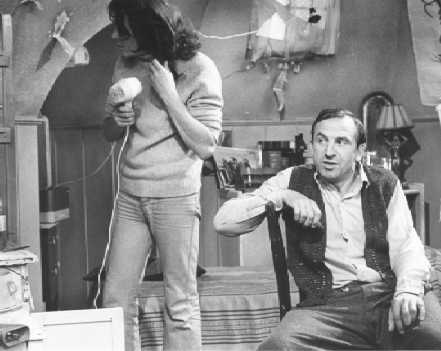
Series
One was broadcast from December 13th 1974 to January 17th 1975, and was
an immediate success. It was a personal triumph for Leonard Rossiter,
his
first sitcom role. Each week, viewers learned more and more about each
of the characters. Rigsby would go to even greater lengths to win
affection
from Miss Jones, while being victim to Alan and Philip's pranks. Rigsby
would carry around his overweight, slothful cat Vienna (which Leonard
hated
off-set. Although a cat-lover, he used to complain that Vienna smelled
awful), barging into the boys' room without knocking, trying to catch
them
'up to something', which they never were. Mocking Philip, his race and
his culture, while trying to be a father-figure to Alan, Rigsby came
over
as cold, pretentious and chauvinistic, but at the same time vulnerable,
a sad, lonely figure of a man who longed for love and happiness in his
twilight years. As Eric Chappell says: "Rigsby wanted to be part of
their
lives, which became irritating for them... and he was always coming
through
doors without knocking, saying he had right of access - which really
meant
access to their lives, not just their rooms." The first series of any
sitcom
is much concerned with establishing the characters and their lives, and
Eric displayed this very well in the scripts, which often drew on the
script
from The Banana Box. We learn that Rigsby did marry, a battle-axe
called
Veronica, but he was 'elated' when she left him. He was a soldier in
World
War Two, and would get out his mementoes or relate one of his yarns at
the slightest mention of the war. Leonard once said of Rigsby: "I knew
people like this. I've sat in pubs with them." And Don Warrington
concurs:
"I think he really caught something about the English in Rigsby - a
sort
of emotional incontinence which one can see in pubs. The one who knows
it all and actually knows nothing. He got that brilliantly."
The
second
series ran from November 7th until December 19th 1975, and saw further
development of the characters. In Episode Four ('Moonlight
& Roses'), Miss Jones is swept off her feet by a librarian
named
Desmond (played by Robin Parkinson), and her departure rocks Rigsby's
world
- until Alan installs artists' nude model Brenda (played by Gay Rose)
into
the vacant room. A conman (Henry McGee) plays on Rigsby's gullibility
to
take his money ('The
Perfect Gentleman'), and the tenants have the last laugh when he
tries
to convince them that the house is haunted by a 'grey lady' ('Things
That Go Bump In The Night'). Although ending on December 19th, the
series appeared to continue for another week when a Boxing Day special
was broadcast on December 26th entitled 'For
The Man Who Has Everything', which sees Rigsby spending Christmas
alone,
opening his own Christmas card, and hoping he will catch someone under
the mistletoe. The boys return home early for some yuletide romancing,
thinking Rigsby is spending the festive season away. A delay in the
writing
of episodes caused conflict with theatre commitments for Frances,
resulting
in her being written out of the episodes
The
Perfect Gentleman, The
Last Of The Big Spenders, Things
That Go Bump In The Night and the Christmas special For
The Man Who Has Everything.
Rising
Damp was absent from British screens for the whole of 1976 (except for
repeats). This was due to Leonard's contract with the BBC filming The
Fall and Rise of Reginald Perrin. But Rising Damp returned for a
third
series on April 12th 1977. Babies ('That's
My Boy'), snakes ('Fawcett's
Python'), a gay playwright ('Stage
Struck') and a hypochondriac ('Suddenly
At Home') all descend on 'Bleak House' for another seven episodes
of
brilliantly-written and even more brilliantly-acted sitcom fun. Frances
de la Tour returned as Miss Jones, and Peter Bowles, Derek Francis, Ann
Beach and Roger Brierley were among the guest stars for Series Three
which
ran until May 24th. By now, Richard Beckinsale had another successful
series
under his belt, Porridge, with Ronnie Barker. And Leonard had created
another
character of sitcom legend, over on BBC1. For those who had never seen
Leonard on stage, the appearance of such disparate characters as Rigsby
and Reginald Perrin gave the viewing public the opinion that theatre
critics
had long- known: that Leonard Rossiter was a fantastically versatile
actor,
hugely-talented, committing staggering energy and vitality to both
performances
on both channels. "I have never known such energy and such pace",
recalls
Eric Chappell. "He could speak quicker than most people, and he could
think
about three different things at the same time, which was useful! He'd
be
remembering his lines, watching the set and the actors, and watching
where
the cameras were. He was really in control."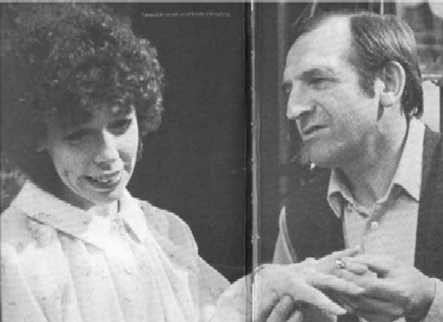
Another
year was to pass before Rising Damp's fourth and final series was
aired.
It featured just six episodes instead of the usual seven, for the
simple
reason that YTV forgot to commission a seventh! (Eric's scripts for
Rising
Damp were commissioned individually). The series ran from April 4th to
May 9th 1978, and saw some of the funniest episodes of all, and
commanding
massive audience figures of over 18 million. Richard Beckinsale had
left
to pursue theatre commitments and the series' director Ronnie Baxter
had
left to direct In Loving Memory, so Vernon Lawrence took over the
directorship.
Nevertheless, the fourth series lost none of its quality: 'Great
Expectations' co-starred Andrew Sachs and Gretchen Franklin in a
family
inheritance tale that goes sour, but turns out for the best in the end.
In 'Pink Carnations', a desperate Rigsby places an ad in a
lonely-hearts
column, only to have it answered by Miss Jones. And in the final
episode,
Rigsby finally proposes to Miss Jones, who accepts. Sadly, she stands
him
up at the church, only to find that Rigsby had gone to the wrong church
anyway.
And so
Rising Damp, one of the greatest sitcoms of all time, came to an end.
It
had won itself a BAFTA for Best Comedy, rocketed Leonard Rossiter to
stardom
and the comedy Hall of Fame, and it had served as a springboard for the
writer Eric Chappell, who went on to write other classic situation
comedies
including Singles, The Bounder, Haggard, Home To Roost, Duty Free and
Only
When I Laugh. The perfection of the scripts, the massive talents of the
actors involved, and the timelessness of the stories and settings
ensure
Rising Damp is as popular today as it has always been.
TV Spin-offs
As with
many British successes, America tried out their own version of Rising
Damp.
In 'Steam Heat', Jack Weston played the landlord of two medical
students,
a nude model and a wrestler, who lived in a boarding house in 27, Joy
Street,
Cambridge, Massachusetts. A pilot was made for CBS by King-Hitzig
Productions,
written by Peter Stone and directed by Bill Persky. It was based on the
Rising Damp episode The Prowler. The preview, in the presence of CBS
programme
planners, was less than favourable, and the channel never even screened
the pilot, let alone commissioned a series. The fundamental problem was
that Americans have no such thing as 'bedsitland' and so the entire
concept
was lost on the audience. A Portuguese version was made and was
well-received,
and Sweden is also planning a version.
Move
On To Rising Damp Story: The Movie
Return
To Rigsby Online
Text (c) Paul Fisher
Pictures (c) their
respective
owners.