Rigsby Online: The
Authorised Rising Damp web site
The Story of Rising Damp
The Play - 'The Banana Box'
Written
by Eric Chappell
Directed by David Scace
(except as noted below).
Performances:
29 November 1970, Hampstead
Theatre Club
Rehearsed Reading only (directed
by John Tydeman)
25 May - 12 June 1971,
Phoenix Theatre, Leicester
(directed by Stephen MacDonald)
Rooksby: Wilfrid Brambell
Noel Parker: Keith Drinkel
Philip Smith: Neville Aurelius
Ruth Jones: Janet Michael
Lucy: Louise Nelson |
12-19
March 1973, Adeline Genee Theatre, East Grinstead
20-31 March 1973, Oxford
Playhouse, Oxford
9-16 April 1973, Theatre
Royal, Newcastle
Rooksby: Leonard Rossiter
Noel Parker: Paul Jones
Philip Smith: Don Warrington
Ruth Jones: Rosemary Leach
Lucy: Elizabeth Adare
17 May - 16 June 1973,
Hampstead Theatre Club, London
25 June - 24 July 1973,
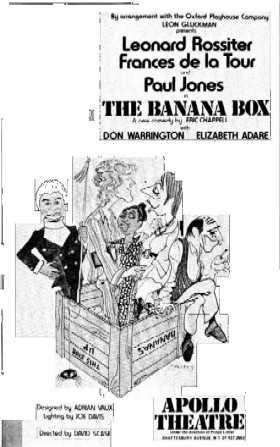
Apollo Theatre, London
Rooksby: Leonard Rossiter
Noel Parker: Paul Jones
Philip Smith: Don Warrington
Ruth Jones: Frances de la
Tour
Lucy: Elizabeth Adare |
Origins
The first
public performance of the play which was to become Rising Damp took place
on Sunday, 29th November 1970. It was only a rehearsed reading, with no
sets and similar to 'televised' radio shows. At the time, its author Eric
Chappell was an auditor for an electricity board, with an ever-increasing
pile of rejection slips for his attempts at fiction and a consequent disillusionment
of his potential as a writer. This was his second play. His first was a
short script called A Long Felt Want, but it was never produced. It did,
however, gain him an agent, John Bassett of Curtis Brown. It also helped
him to regain his confidence as a writer, and he started to create another
play, this time a full-length one. The idea came from a newspaper article
which concerned a black man who had stayed as a hotel guest for twelve
months pretending to be an African prince, and therefore commanding respect
- and getting it. The title - The Banana Box - was derived from a comment
made in a debate about the entitlement of non-British born residents to
call themselves 'British': "If a cat has kittens in a banana box, what
do you get - kittens or bananas?".
Characterisation
The Banana
Box picked up on both of these themes - the place of blacks in society
(and the opinions of those who were against it) and the attempt to answer
the question of who exactly is British, and why. The character of the landlord
of the bedsit Rooksby (he only became Rigsby in theTV series) was
based on several people who Eric Chappell knew, and their cynical attitude
to the influx of African and Afro-Caribbean citizens onto English shores.
Philip was obviously based on the hotel guest already mentioned, with his
tales of African culture being gleaned from many evenings for Eric at the
local library. Miss Jones - Eric's first female character - was deliberately
coy, but a gentle, forgiving soul, and the love interest for Rooksby. His
frustrations at her coolness towards him are multiplied when it becomes
clear she has eyes only for Philip. The play is based in a university town,
so Philip is a student of Town and Country Planning, and there are two
more scholarly tenants - Noel Parker and Lucy. At the end of the play,
Noel and Lucy have become an item, and Philip has had to admit that his
royal status is all pretence, and that he is in fact from Croydon. None
of the cast who took part in the rehearsed reading were present when the
play entered full production.
Curtain Up
The rehearsed
reading was very well received, by audience and critics alike. The rights
to stage the play were bought by a management company (headed by Michael
Codron), and it was decided that the play should premiere 'in the provinces',
ie. outside of London. It was offered to The Phoenix Theatre in Leicester
who, with knowledge that its author was a local lad, willingly agreed to
stage it. Also new to The Phoenix was its director, Stephen McDonald. He
worked with Eric to hone the script into a well-developed and constantly-interesting
and absorbing storyline. Stephen's original plans for the actors to play
Rooksby and Miss Jones were married couple Leonard Rossiter and Gillian
Raine, but Leonard was committed to another play and couldn't be released.
Instead, the theatre obtained a coup by landing Wilfrid Brambell. With
Steptoe and Son still a massive audience-puller on TV, Wilfrid assured
the play's success. He also achieved good publicity for the theatre, and
soon other big stars of the day were happy about working there. The play
recouped its costs, although it wasn't a runaway success, and Michael Codron
decided against taking it to London's West End. "I wasn't convinced by
Wilfrid Brambell's performance", Michael says. "Overall I thought it was
best not to pursue the play any further."
London calling
After
the final Leicester performance on 12th June 1971, it was nearly two years
before the play was performed again, this time in London at the Adeline
Genee Theatre in East Grinstead. By this time a lot had changed. There
were new South African backers, a new director (David Scace), a completely
new cast (now including Leonard Rossiter and Don Warrington), and Eric
also had a new agent, Bryan Drew. After a week of shows at East Grinstead,
the play moved to Oxford for the second half of March 1973, and then to
Newcastle-upon-Tyne for the first half of April. It then returned to London,
with a month's run at The Hampstead Theatre Club (where the original rehearsed
reading had taken place three years earlier), and then to the prestigious
Apollo Theatre on Shaftesbury Avenue from 25th June to 24th July. The critics
warmed to the play immediately, and only certain weaknesses of the plot
let it down. However, the long-running production of Alan Bennett's Habeas
Corpus in the theatre next door sapped The Banana Box's audience, and it
closed after only one month.
Evolution
Ironically
it was not, after all, the move to London which started the transformation
of The Banana Box into the sitcom we know today. It was in fact a performance
of the play while on its short tour to Newcastle-upon-Tyne in April 1973.
One of the audience for a performance there was John Duncan, then Head
of Light Entertainment at Yorkshire Television. He thought the storyline
didn't quite fit the medium of a stage play, but thought it perfect sitcom
material...
Move
On To Rising Damp Story: The TV Series
Return
To Rigsby Online
Text (c) Paul Fisher
Pictures (c) their respective owners.