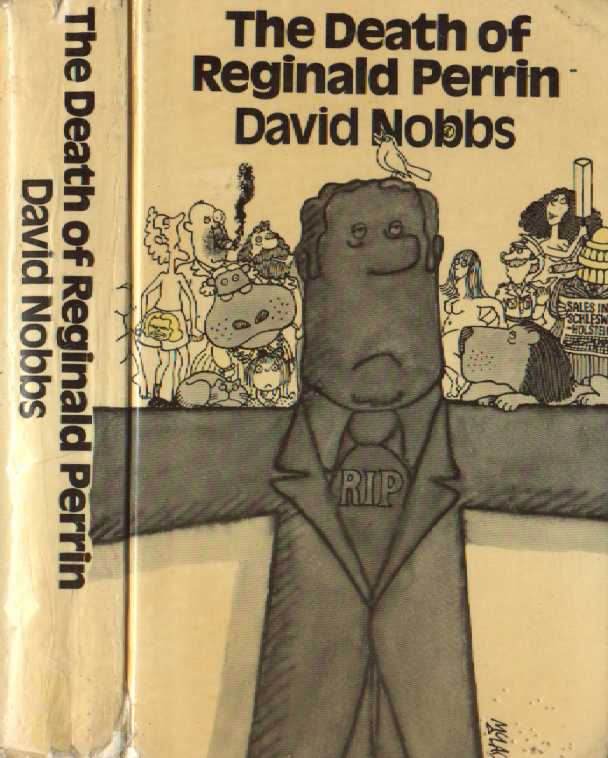
In 1974, David Nobbs had established himself as one of Britain’s top comedy writers, having written material for Dick Emery, Les Dawson, Ken Dodd, Frankie Howerd, Jimmy Tarbuck and Tommy Cooper. It was at this time, while a regular writer for The Two Ronnies, that the BBC invited him to submit an idea for a play about social problems in contemporary society, one of a series of plays to be made by BBC Pebble Mill in Birmingham. The synopsis he submitted concerned a man who was going mad from doing the same old suburban commuter routine every day. His idea was rejected as being ‘unsuitable’. But he persevered with the idea and instead turned it into a novel.
The manuscript for ‘The Death Of Reginald Perrin’ was sent to his agent Jonathan Clowes, who submitted it to Methuen, the publishers of his three earlier novels ‘The Itinerant Lodger’, ‘Ostrich Country’ and ‘A Piece Of The Sky Is Missing’. Again, the script was returned rejected, with the advice to alter the ending, (the main character, a certain Reginald Perrin, finished up in a mental home). The revised story became the one familiar to us, and the script was again sent to various publishers. It was accepted by Victor Gollancz and first published on the 22nd May 1975, to favourable reviews.
The idea for the novel had been subconsciously stirring in the mind of David Nobbs since his childhood. Although not autobiographical, David did used to catch the same train every morning to his prep. school, surrounded by office worker commuters in their pinstripe suits, with briefcase, rolled umbrella and a newspaper under the arm. He has always prided himself on being very observant of the world around him, noticing the quirks of life and the subtleties that go unnoticed by many in their daily lives – a gift that all good authors should have.
The BBC commissioned a pilot to be made, to ‘test the water’ for an entire series based on the novel. The pilot episode was broadcast on September 8th 1976. The BBC decided it was strong enough and got a good enough reaction from the viewing public that the rest of the novel was commissioned to be serialised, and David wrote the scripts.
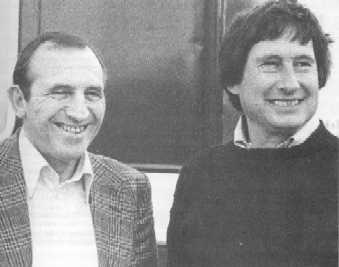
With Reggie described in the novel as “a big man, almost six foot, with round shoulders…”, David thought Ronnie Barker would be an ideal candidate to play the lead, but Ronnie was tied up with The Two Ronnies, Porridge and his new sitcom Open All Hours. The BBC’s Head of Comedy at the time, Jimmy Gilbert, had seen Leonard Rossiter’s rise to fame (on television at least, he was
 already
packing out theatres nationwide) as Rigsby in ITV’s Rising Damp, and he
wanted him for a BBC project, so Leonard was cast.
already
packing out theatres nationwide) as Rigsby in ITV’s Rising Damp, and he
wanted him for a BBC project, so Leonard was cast.
The first series was a huge success, thanks to a brilliant script - every line appeared to be honed to perfection, like a gemcutter works with a diamond – and a fantastically strong cast. The BBC were quick to ask David for a second novel, although he had his doubts to begin with. After all, the story had run its course - Reggie was back with Elizabeth and they were presumed to have “lived happily ever after”, but David had another great (or should that be Grot?) idea for a second novel. It, too, was one of the most popular sitcoms of the year, with a peak of 10.5 million viewers. The third series, centring on the Perrins community was never expected to match the genius idea that was Grot, but still attracted huge audiences, reaching 10.2 million at its height – again, a testament to good writing and a strong cast. All three series have earned that undefinable label ‘classic television’, and are still repeated worldwide today. The books, too, continue to sell well, with the first three novels recently published as a one-volume omnibus, and the first three series now available for the first time unedited on video.